October 16, 2026 · OHIO CANNABIS LIVE
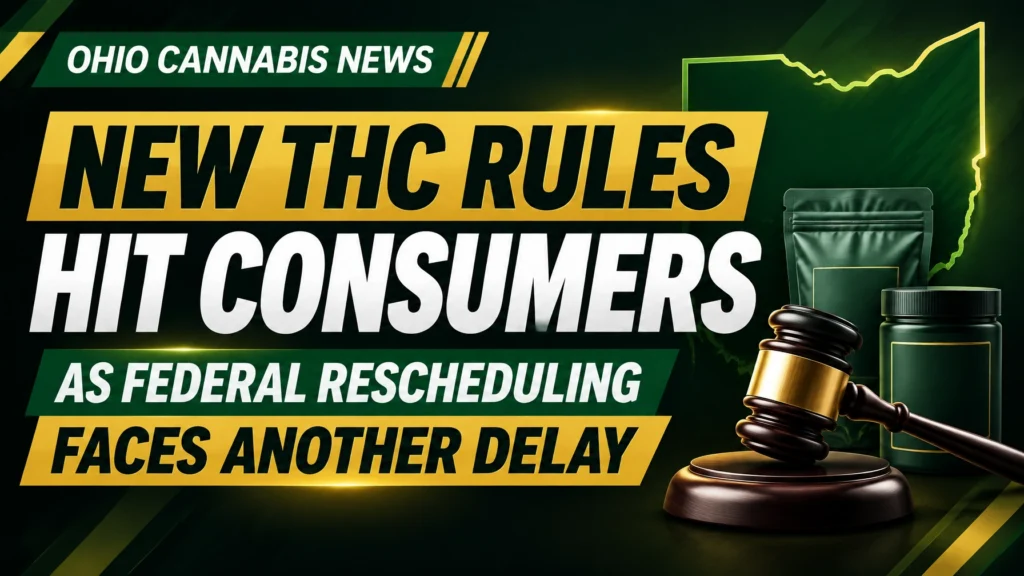
Ohio Cannabis News This Week: New THC Rules Hit Consumers as Federal Rescheduling Faces Another Delay
October 16, 2026 | Ohio Cannabis Live
Ohio cannabis consumers are adjusting to major new product restrictions while the biggest federal marijuana policy case in years has hit another procedural delay.
In Ohio, new THC and packaging limits are changing what dispensaries can put on shelves and how much cannabis can be sold in a single package. Nationally, the fight over marijuana rescheduling continues, with a DEA judge now considering whether opponents should be allowed to reopen parts of the hearing process.
Here is what Ohio cannabis consumers, patients and businesses need to know this week.
Ohio's New THC Limits Are Starting to Hit the Market
One of the biggest Ohio cannabis stories continues to be the state's new product and packaging requirements.
Adult-use edibles are now generally limited to 10 milligrams of THC per serving and 100 milligrams per package. The new rules also impose restrictions across numerous other product categories, including vapes, concentrates, beverages and flower. Cannabis sold directly to consumers generally cannot exceed 90 percent THC.
That may sound like a simple regulatory change, but the effect can be much bigger at the checkout counter.
ABC6 recently spoke with Ohio Cannabis Company co-owner Zachary Bradford, who explained that some products previously containing 500 milligrams of THC per package may now have to be sold in multiple 100-milligram packages. That means consumers looking for the same total amount could potentially have to purchase several packages instead of one.
For patients and adult-use consumers, that raises an obvious question: Will less THC per package mean paying more money for essentially the same amount of cannabis?
That is something Ohio Cannabis Live will continue watching as the new products replace older inventory.
Ohio Regulators Keep Updating the Rules
The Ohio Division of Cannabis Control continues to issue guidance as the state's medical and adult-use systems evolve.
The Division currently lists an Advertising Guidance Update dated October 5, 2026, along with recent packaging, labeling and THC-content guidance.
Ohio's current advertising regulations are intended to prevent cannabis advertising from targeting minors and prohibit misleading information, unverified health claims and certain obscene or indecent content.
For Ohio cannabis businesses, the message is simple: compliance is not something you check once and forget about. Operators have to keep watching the rules.
Ohio's Cannabis Industry Is Approaching $2 Billion in Reported Product Sales
Ohio's regulated cannabis market continues to grow.
According to the Division of Cannabis Control's latest published dashboard figures, Ohio had 231 dual-use dispensaries with certificates of operation, another 48 provisional dispensary licenses, 37 cultivator certificates of operation, 45 processor certificates and six testing laboratories as of the dates listed by the agency.
The DCC also reported approximately $1.94 billion in total product sales through September 26, 2026.
Those numbers make the regulatory decisions surrounding product limits, advertising, testing and pricing even more important. Ohio cannabis is no longer a small experiment. It is a major regulated market serving hundreds of thousands of consumers and patients.
National Cannabis News
Marijuana Rescheduling Isn't Dead, But It Is Delayed Again
The biggest national cannabis story this week is once again federal marijuana rescheduling.
DEA Chief Administrative Law Judge Derek Julius ordered the agency on October 14 to respond to a request from opponents of rescheduling who want additional testimony and document discovery.
The DEA response is due October 21.
Most importantly, the judge said the broader matter remains stayed while the tribunal considers the pending motions.
That does not mean the Schedule III proceeding has been canceled.
It means another procedural fight has to be resolved before the process can move forward.
Opponents are attempting to use a recently released federal watchdog report to challenge how federal agencies evaluated marijuana.
Why the GAO Report Matters
The Government Accountability Office released a report on September 23 examining how the federal government handles drug scheduling decisions.
GAO found that DEA and FDA lack comprehensive written policies and procedures governing parts of the scheduling evaluation process and recommended improvements designed to make those decisions more consistent.
That report has now become part of the cannabis fight.
Opponents of marijuana rescheduling want additional testimony and document discovery related to the findings.
DEA has taken a different position. The agency has said it does not necessarily object to the GAO report being added to the record but argues that the report does not provide new evidence that changes the central marijuana rescheduling question.
So once again, cannabis policy is stuck in a fight about federal procedure.
Cannabis Attitudes Are Changing in Professional Sports
Another interesting story this week came from NFL-funded research examining attitudes about cannabis in professional sports.
The research found that attitudes are evolving and that some medical professionals increasingly view cannabis as potentially safer or more useful than opioids, alcohol or certain prescription medications in some circumstances. At the same time, stigma and uncertainty continue to make conversations between athletes and medical personnel more difficult.
That does not mean the NFL has declared marijuana a treatment or universally approved its use.
It does show just how dramatically the cannabis conversation in professional sports has changed.
The Hemp Fight Isn't Going Away
The national fight over hemp-derived THC also continues.
There is a growing divide between people calling for tighter restrictions or prohibition and those arguing that hemp-derived THC beverages and other products should be regulated rather than eliminated.
Even within the broader cannabis industry, there is no unified position. Some marijuana businesses see intoxicating hemp products as unfair competition, while hemp operators argue that responsible regulation makes more sense than another prohibition.
Expect that fight to continue.
What Does All This Mean for Ohio?
Ohio cannabis consumers are dealing with changes coming from two directions at the same time.
At the state level, regulators are changing what products can look like, how much THC they can contain and how cannabis businesses can advertise.
At the federal level, the government continues debating the legal classification of marijuana itself.
Federal Schedule III treatment would be significant, but it should not be confused with nationwide recreational legalization.
Ohio would still have its own cannabis laws, licensing system and regulatory structure.
The federal changes could eventually affect areas such as cannabis research, taxation, medical marijuana businesses and the relationship between state programs and federal law.
But there are still a lot of unanswered questions.
What We're Watching Next
The next major date is October 21, when DEA has been ordered to respond to the latest request seeking additional testimony and discovery in the marijuana rescheduling proceeding.
Here in Ohio, we will also be watching dispensary pricing and product availability as consumers experience the state's new THC and packaging rules firsthand.
Are you paying more for products that contain less THC?
Are products you previously purchased disappearing from dispensary shelves?
Ohio Cannabis Live wants to hear what consumers and patients are actually experiencing.
Follow Ohio Cannabis Live for independent Ohio cannabis news, interviews, policy coverage and updates from across the cannabis community.
And catch Ohio Cannabis Live every Friday for our weekly breakdown of the stories affecting Ohio and the national cannabis industry.